

When I launched the Freedom Spike, I said it was field-tested. And it was — in my front yard. I ran it through different spikes and configurations, everything worked, and I felt good about it. But there's a difference between front-yard testing and really living with something out in the world, trip after trip, in conditions you don't get to pick. This summer I did the second kind of testing. Here's the honest story of what happened, what broke, and what I did about it.
I also made a full video walking through the whole thing — showing the actual broken parts, the failure points, and the redesign. If you'd rather watch than read, click below:
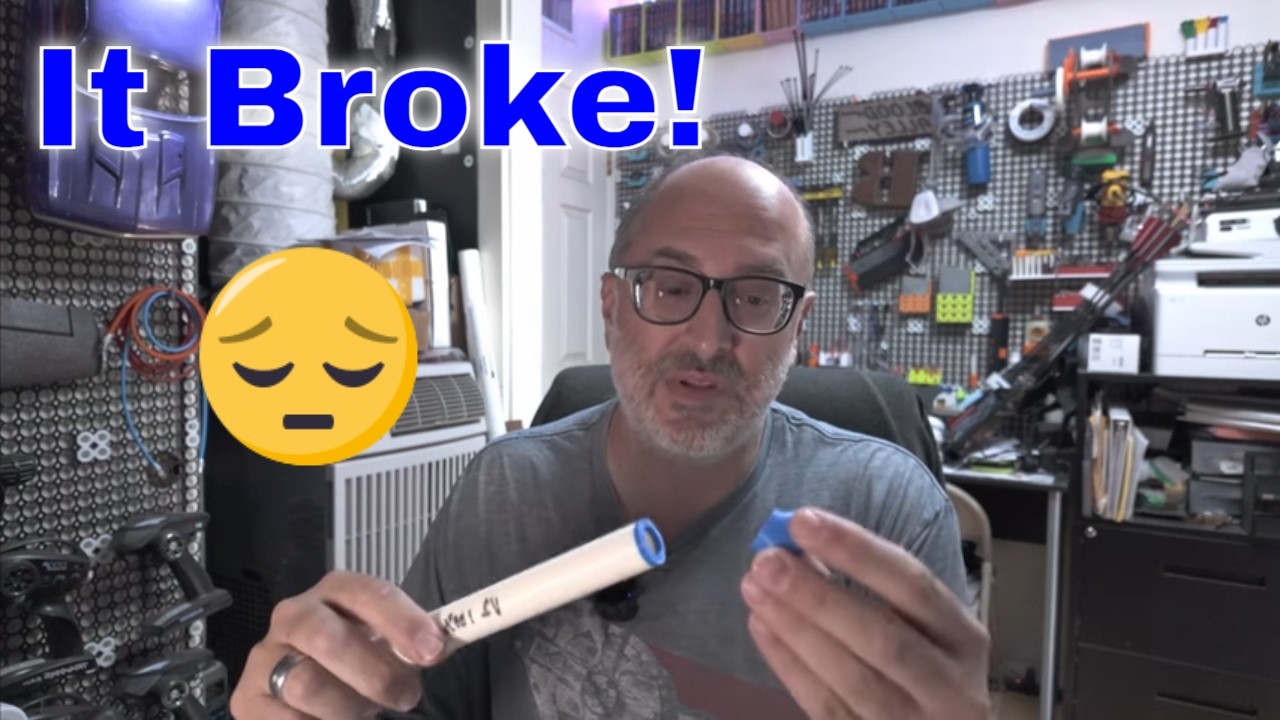
▶ Watch: What happened when I field-tested the Freedom Spike
The whole point of the Freedom Spike
Quick refresher for anyone new here. The Freedom Spike is a lightweight ground mount for portable radio masts. Hammer the aluminum spike into the ground, screw on the Freedom Spike, slide your mast over the top, and you're on the air. No guy lines, no bungees, no hunting for the perfect tree. It's built for backpacking and ultralight field use, which means it uses an aluminum spike instead of steel and keeps the whole package as light as I can make it.
That lightweight focus matters for the rest of this story, so hold onto it.
Then I took it camping
A month or two after launch, I headed out on a week-long family camping trip. While I was out there I set up a bunch of masts and antennas, ran my radios, and had a great time — and the Freedom Spike was getting a lot of real use. But using it for real, in the field, is where I started noticing failure points. A few of them broke on me.
Now, I want to be straight about this, because that's the whole way I do things here. I make these myself, so I had a few extras with me, and honestly a product breaking in the field isn't the end of the world to me. It's information. It's the exact reason I use my own gear instead of just designing it and shipping it. When something fails, it tells me where the design was wrong, and it points me at the fix. So right there at camp I started paying attention to where and why it was breaking.
What actually broke, and why
The original Freedom Spike had a shape that stepped down in the middle, almost like a dog bone. And that shape turned out to be the problem. The breaks weren't happening at the threads like you might expect. They were happening at the thick choke points where the diameter steps down, because that's exactly where the force was concentrating. One of mine actually sheared off at both ends. Every place the diameter changes is a spot where stress builds up, and under side load, that's where it wanted to snap.
At first I assumed it was a printing problem. These are 3D printed, and I'd been printing them vertically, so I figured the layer lines were the weak point. I printed out a whole batch of test versions, labeled them, tried different infill patterns, went all the way up to 100% infill, and even started printing in different orientations like a 45-degree angle. Then I load-tested them with a force meter.
The results were all over the place — not very consistent at all. But one thing was consistent: it kept breaking at the same choke points every time. That's what told me the real issue wasn't how solid the part was or how it was printed. It was the geometry. You can't fix a stress concentration by adding material or changing print settings. The shape itself had to change.
The redesign
So I threw out the dog-bone shape entirely and went to a straight shaft. Each one is sized to fit snugly inside the specific mast it's made for, with very little play. Because there's no step-down anymore, there's no single point where force concentrates — the load spreads evenly along the whole length. Inside, a gyroid infill pattern gives it real dimensional strength without a lot of weight, and it only added about 21% more plastic to do it. For that jump in durability, it's a trade I'll take every time.
A couple of other changes came out of the testing too. I'm now printing them at a 45-degree angle, so the layer lines aren't all running horizontally, which helps with strength. And I finish each one — sanding plus an acetone vapor smoothing pass — so it has a clean, smooth surface that slides into your mast without catching, scratching, or ribbing. If you buy one now, that's what you'll get.

Where it stands now, honestly
I'll tell you the same thing I say in the video: this is the lightweight option. It is not a heavy-duty steel ground anchor, and it was never trying to be. If you're going to load a mast hard — a lot of weight, high wind — there are heavier-duty spikes out there and you should bring one of those. This one is built to be light and packable, and that means it's a little more delicate by design.
With the redesign, the weak point has moved. The one spot that could still separate under enough load is down at the base — but in my own testing, getting it to fail there took so much side load that I was actually cracking the fiberglass mast itself before the spike gave out. At that point you're loading things way harder than any normal field setup ever will. What the redesign did was take the failures that were happening too easily in the shaft and make the whole thing far more forgiving under the loads it'll actually see. It's significantly stronger than the original, and it's the version I'm confident putting my name on.
Taking care of the early buyers
If you already bought one of the original dog-bone versions, you don't need to do anything. Every one of those customers has already been contacted, and a redesigned replacement is on its way to you, free. You've already got the aluminum spike, so you're just getting the updated plastic piece with the brass inserts installed, ready to thread on.
That's the whole idea behind Nomad Gearworks. Small batch, built and used by one person, changed and improved based on what actually happens out in the field. This is exactly what that looks like in practice. I just want to make sure these things work, that people are happy, and that it solves the problem for you the same way it solves it for me.
If you've got questions, or you've run one of these hard and want to tell me how it held up — good or bad — I genuinely want to hear it. That feedback is what makes the next version better.
73,
Ben
Nomad Gearworks